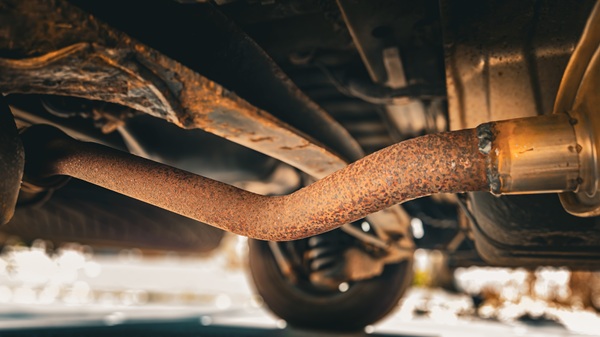
Your hybrid uses less gasoline than your previous car, so you might expect its exhaust system to have an easier life too. Then you notice rust underneath or hear a new rasp when the engine starts. How can equipment that operates less often still develop corrosion?
Hybrid operation can influence the temperature and moisture conditions inside an exhaust system, particularly during short trips. However, hybrids are not automatically destined to rust faster than every gasoline car. Driving patterns, road exposure, component materials, and system condition all affect the outcome. Understanding those factors helps explain what the inspection should look for.
Exhaust Moisture Begins With Normal Engine Operation
Burning gasoline produces water vapor along with other combustion products. When that vapor reaches cooler exhaust components, some moisture can condense. Water appearing at the tailpipe during a cold start can therefore be normal and does not by itself prove a cooling-system failure.
The issue is how much moisture remains and how the system handles it over time. Repeated heating and cooling can leave water inside pipes and mufflers. Internal corrosion can develop when those conditions persist. The exhaust may look reasonably sound on the outside while a seam or internal area has weakened.
Hybrid Engine Cycling Can Change Exhaust Temperatures
A hybrid may turn its engine off during portions of a drive and restart it when power, battery charge, or other operating needs require it. That behavior can reduce the continuous engine-running time available to keep parts of the exhaust hot.
The effect depends on the vehicle and the trip. A hybrid covering longer distances may experience very different exhaust temperatures from one making brief errands. Controls also vary between models. It is more accurate to connect potential moisture retention with the actual duty cycle than to assume the hybrid badge alone explains why a particular pipe has corroded.
Short Hybrid Trips Can Leave Condensation Behind
During a short trip, the engine and exhaust may warm partly and then cool again before moisture has had much opportunity to evaporate. Repeating that cycle can encourage internal corrosion. A conventional gasoline vehicle used the same way can experience a similar problem.
Think about your regular Fort Madison driving. Is the car used for short stops close to home, or does it regularly travel farther? That information helps give the exhaust condition context. There is no universal highway drive that reverses established rust, and deliberately forcing the hybrid engine to run is not a substitute for the vehicle's intended operation.
Road Moisture and Salt Can Attack Exhaust Pipes Externally
The outside of the exhaust is exposed to water, road debris, and winter contaminants. Salt can accelerate corrosion on susceptible materials, particularly around seams, flanges, clamps, and other places where moisture collects. Hybrid fuel savings do not remove that external exposure.
Inspecting the underside is therefore useful even when the engine runs quietly and there is no warning light. The shop can look at pipes, connections, supports, shields, and the areas around them. Regular appropriate cleaning can help remove exterior contamination, but it cannot restore metal already lost or seal a developing exhaust leak.
Exhaust Materials Affect Rust Resistance
Exhaust systems use different metals, coatings, and construction methods. Stainless steel can improve corrosion resistance compared with some other materials, but the particular grade and application influence durability. Connections, welds, and attached hardware can also age differently from the main pipe.
A replacement estimate should explain which components have failed and what parts are proposed. A rusty clamp is a different repair from a perforated muffler or weakened pipe section. The goal is a suitable repair for the vehicle, including its fit, heat protection, noise control, and emissions equipment. Price alone does not describe those differences.
Surface Exhaust Rust and Structural Corrosion Are Different
A brown surface does not automatically mean the pipe needs immediate replacement. The inspection needs to assess whether the corrosion is superficial or has weakened the metal, damaged a connection, or created a leak. Location and surrounding condition help define the repair.
A new ticking, rasping, or louder exhaust note can accompany a leak, but sound alone does not identify the exact component. Some hybrids make exhaust changes more noticeable when the engine starts after quiet electric driving. Tell us whether the sound occurs only at startup, changes when warm, or continues throughout engine operation.
Watch for These Hybrid Exhaust Changes
These five observations are useful reasons to arrange an inspection.
- A new exhaust sound when the gasoline engine starts or accelerates.
- Visible corrosion around pipe joints, flanges, or supports.
- A rattle from a shield or a component that appears loose.
- An exhaust odor noticed around or inside the vehicle.
- A recent impact underneath the car followed by a change in sound.
Exhaust entering the cabin needs prompt attention. Move to a safe place, avoid further exposure, and arrange help. Carbon monoxide cannot be identified reliably by smell. An odor is a reason to investigate the system, not a way to measure whether continuing to drive is safe.
Hybrid Exhaust Repairs Need Proper Service Procedures
An engine that is quiet is not necessarily switched off on a hybrid. It can restart automatically while the vehicle is ready to operate. Inspection and repairs need the appropriate shutdown, lifting, and safety procedures for the particular model.
Once the condition is confirmed, the repair may involve hardware, a leaking joint, a damaged pipe, or a larger assembly. Have the surrounding system assessed so a repair is attached to sound components. A local fix may suit limited damage, while extensive corrosion can require a broader replacement. The explanation should follow the actual condition underneath your car.
Get Hybrid Exhaust Service in Fort Madison, IA
Griffin Muffler & Brake Center in Fort Madison, IA, can inspect exhaust corrosion, new noises, and damaged connections. Tell us about your hybrid's driving pattern and when you notice the change so we can discuss the appropriate repair.
Contact us to schedule an exhaust-system inspection for your hybrid.